Key takeaways
- Laravel is excellent for business applications, admin-heavy platforms and fast delivery with a small team.
- Node.js shines for real-time features, high-concurrency APIs and teams that want one language across front and back end.
- Both scale well when architected properly — team skills and product shape matter more than benchmarks.
Laravel and Node.js in one minute
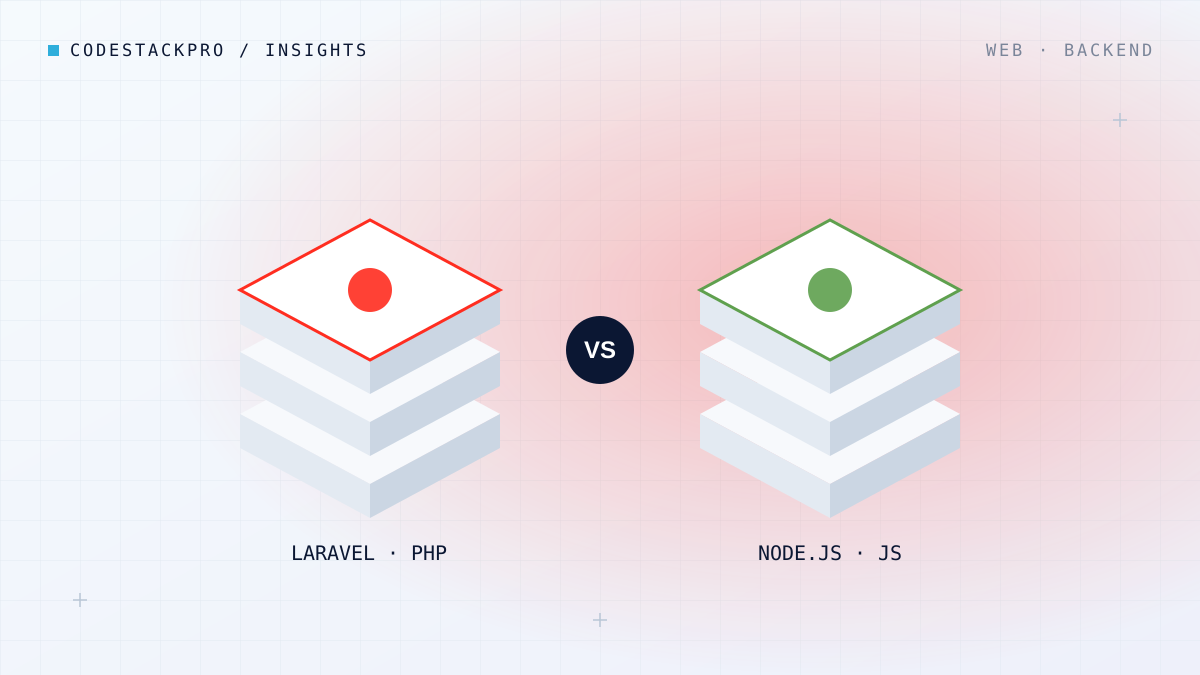
Laravel is a PHP framework with batteries included: routing, authentication, queues, an ORM (Eloquent), mail, scheduling and an admin ecosystem. Node.js is a JavaScript runtime; you typically pair it with a framework such as Express, NestJS or Fastify and assemble the pieces you need.
| Laravel (PHP) | Node.js (JavaScript/TypeScript) | |
|---|---|---|
| Speed to first release | Very fast — conventions built in | Fast with NestJS; more setup with minimal frameworks |
| Real-time features | Good (Reverb, Echo, queues) | Excellent (WebSockets, streaming) |
| Typical sweet spot | Business apps, portals, SaaS, e-commerce back ends | Real-time apps, APIs, microservices, JS-heavy teams |
| Hosting | Affordable and widely available | Containers, serverless or PaaS |
When Laravel is the better choice
- You need a business application — CRM, booking system, internal tools or a SaaS MVP — shipped quickly.
- Your product is admin-heavy: forms, reports, roles and workflows.
- You want low maintenance cost and an easy-to-hire PHP talent pool.
We have built and maintained Laravel and CodeIgniter platforms since our earliest years, including upgrades of legacy PHP systems to modern Laravel.
When Node.js is the better choice
- Your product depends on real-time features: chat, live dashboards, collaboration or streaming.
- You want one language (TypeScript) across React front end, back end and serverless functions.
- You are building high-concurrency APIs or microservices.
Can you use both?
Yes — and many mature products do. A common pattern is a Laravel core for business logic and administration, with a Node.js service handling real-time events. The key is clear boundaries and good API contracts.
Our recommendation
Start from the product, not the framework. During discovery we look at your features, your team, your integrations and your five-year maintenance cost, then put the recommendation in writing. Explore our web development services or see every stack we use on our technologies page.